Interview: Mary Folberg
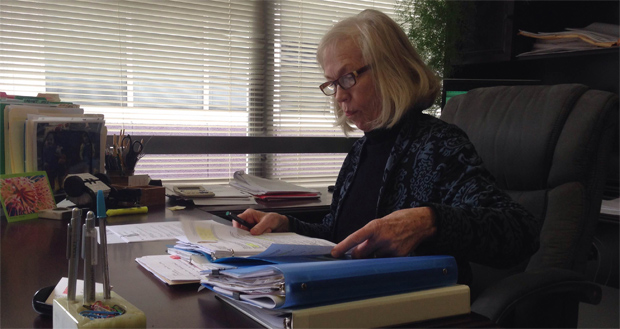 In 1993, Mary Vinton Folberg started Northwest Academy, a 26-student high school with two full-time teachers. That was nearly 19 years ago. The school now enrolls more than 200 students in grades 6-12, and has arts and academic classrooms in five buildings located in Portland’s cultural district. Building a school from scratch is hard work, and after 50 years of experience in education, Folberg is ready to retire. The iJournalism class sat down with the Head of School to discuss her expansive career in education.
So first of all, congratulations on your long career.
Thank you! As you know, when you get to a certain age, if you’ve been at it, it just keeps going and going.
What did you say to the staff?
My first sentence was, I think, “Guys I’m going to hang it up finally.” I’ve been in education for 50 years and it really did seem like now it was time to stop. The school has gotten big enough. I don’t have as much contact with kids and parents and teachers and that was the part I really enjoyed. I’m not a big fan of pushing papers around and red tape and all that stuff.
I know that people have asked you for years when it was going to happen…
Oh, I know. People would always ask when it was going to happen and I would always say three to five years. I gave the board a choice,: that I was ready to go this year or next year, at the longest two years, while they looked for somebody. I think the board is very eager to get the school stabilized in a long-term, permanent home and they know I’ve been working on that and they knew that was one of my goals and I hadn’t fulfilled that goal. So what they offered me was to continue working with the school on that piece, while somebody else takes over at being head of the school. So I jumped at that chance because we’re not going to survive in downtown locations with the real estate prices just climbing. We’ve got to stabilize that piece of it and have control over our own facilities.
Are you considering a location that’s not downtown?
No. We feel that our identity is that of an urban school and we love the partnerships that we have with Portland State, the Film Center, transportation hub, all those things. Being an urban school differentiates us from Catlin [Gabel] and OES [Oregon Episcopal School] with those big campuses… we’re a little different from that and we need to keep that identity.
So what led you to this decision and how did you know, okay, it’s probably time?
Well, I’ve kind of known it’s probably coming to be time. Sometimes you just have to jump in and do it. I could have put it off years and years and I just decided and especially when we hired Debbie Hutchins [Chief Advancement Officer] and she needed me to talk to donors and real-estate people and work on the development of the school’s long-term home.
Now that the decision has been made, how do you feel?
I feel really relieved. I’m going to really miss interactions with kids.
So you had mentioned that you’ll stay on in some capacity?
I’m probably going to work out of the development office.
How are you going to feel once being the “benevolent dictator” and then seeing the school maybe going in a different direction?
It’s not been a benevolent dictatorship for a long time. When it started out I said, “This is a benevolent dictatorship, guys, and when we get like-minded people on board, that is teachers and staff that believe in the way that we do high school education, then it will become more democratic and we’ll cease to be so much of a dictatorship.” I think it’s the only way you can get something started. I did that with the Jefferson dance program and eventually, these things bloom, so a lot of people are making decisions, you just want to make sure that the people who are making the decisions are the ones that understand our philosophy.
Tell me about your morning when you were on your way here to announce your retirement. Take me step by step. How you were feeling?
I was nervous, I was not feeling ambivalent, but some of these teachers and faculty had been working here for a long time. Those are the people who really mean a lot to me.
I noticed that when you made the announcement to the staff you were pretty brief on what you had to say.
Well, I didn’t want to get too emotional, so I thought that brevity would get me through it.
And how did the staff react to you privately afterward?
Some tears, some great notes, hugs; a lot of support. Pretty poignant.
There’s going to be a lot to celebrate because it’s been 50 years of a pretty amazing achievement: the Jefferson Dancers and the Northwest Academy.
I think of myself as an educational entrepreneur and it’s one reason why I think the school could get better now. It’s no longer an entrepreneurial school. In the old days, in our first year we had 26 kids and it was three or four teachers and me and we just did it all, we did everything. Then it grew to 44 and it kept growing. That’s the part I really enjoyed, I like developing a project and seeing if we could pull it off. Then once it gets to be a really big entity, it’s not quite as much fun for me.
Is there anything from the original iteration of the school that you feel like we could get back to more?
Yeah, I’m really scared of this school developing this huge administrative bureaucracy like so many independent schools. The work that goes on in the classroom by you guys gets forgotten or gets at least put aside. To be successful and survive, the school has to be teacher and student-centric. It has to be. I think the culture that we’ve created has really been sustained by students. When we sat down with those first 26 kids and we took anybody that walked in. There was no scrutiny. I said, “What do you want this school to be and what don’t you want it to be?” Across the board they didn’t want cliques, they didn’t want put-downs, they wanted to be in a place where all kinds of people would be accepted. Our students have kept it that way, that’s why we’ve been able to assimilate so many students that had been ostracized or nobody understood at a prior educational setting and we like them. In schools where it’s cool to cut class and the best conversations are going on at a downtown coffee shop, you’re not going to have high achievers and teachers who really love being there.
What do you consider to be your top three or four achievements as an educator?
Well, bringing dance into the public education system in Oregon was significant. When I was teaching in Oakland, California, it was an urban high school. Almost every school in Oakland had a dance studio. It was just considered to be part of the program. So when I came up here, I had a newborn and I really didn’t want the paper load that I would have in English. So I thought, “Maybe I’ll start a dance program.” So I proposed the idea to all these principals and I got two high schools calling me back, which were Adams and Jefferson and I took the job at Jefferson. But my background was really inner-city schools. The two years I was in Oakland, that was the time of the Black Panthers and they were arming kids. I remember one day, this kid came in and put his pistol on his desk and I went, “Would you mind putting that gun back in your locker? It makes me nervous and gets me off-task when I’m trying to teach.” You had to be strong and you had to also have the student’s support. We were closed down for six weeks because of race riots. The two years I was there, we had one girl killed in the hallways, we had one teacher attacked and his collarbone was broken. It was a tough school. So I come up to Jefferson, I’m starting a dance program and people are telling me that this is the city school, the rough school in Portland. It seemed so clean cut to me compared to what I had been through in Oakland. I’m very proud of the dance program. I had a lot to do with development of the theaters in the Performing Arts Center, the Newmark and the Winningstad specifically. That’s made a big difference in the Portland arts. I think out of everything, the thing that I’m most proud of is this school.
Because?
Because it’s closer to the way I think high school education ought to be. You know, you’re always working for the kind of rigor that you know will give everybody here, all students, some real choices in life. An ability to do anything they want to do. At the same time, you’re always walking a tightrope to be sure you don’t stress kids out and that they enjoy their education. It’s always a balancing act, to make sure everyone is relaxed and comfortable, but to have them doing high level work.
Related Posts


About The Author

Pigeon Press Staff
The Pigeon Press staff is committed to truth, justice, accuracy and the American way.
Thank you for this lovely interview, revealing a true hero for generations of Portland young people. And thank you, Mary, for your ongoing dedication and tremendous gifts to education and the arts.