Interview: Revan Williams
 Revan Williams, Admissions Assistant at Northwest Academy, spent three years after college teaching English in Japan. He went to Japan with the Japan Exchange and Teaching Program (JET). He was positioned in Toyama-ken, a small industrial prefecture in mid-western Japan. He ate some crazy things, and was in the country during the 9.0 earthquake.
How did you decide that you wanted to go abroad after college?
I guess I just wanted to live in a different country and see what things were like over there. Kinda get a different perspective. I’ve lived in America my whole life and traveled a lot as a kid. It seemed like a good opportunity to live somewhere. And I happened to speak Japanese, so Japan it was.
So you chose Japan because you spoke Japanese?
I also understood the culture of it. I like a lot of Japanese films. In high school I was an Anime geek. You know, typical reasons, I think.
Did you pick Toyama-ken as the place you wanted to go, or were you assigned?
No, in fact, basically no one chooses Toyama-ken. It’s sort of the middle of nowhere. The Japanese word for it is inaka, which means countryside, but it’s used in a sort of mocking way. The same way some Americans might refer to the deep rural American South.
Are you fluent in Japanese?
I’m conversational. I wouldn’t say I’m fluent though.
So was there a tough language barrier when you got to Japan not being fluent?
Yes, I would say so. My supervisor actually didn’t speak any English, so our only communication was in Japanese, so a lot of the time there would be specific vocabulary I hadn’t been exposed to. For example, when she was telling me about my pension, or any number of employment benefits that I would have had no reason to learn the words for it in college.
How were the kids that you were teaching? What age were they?
I taught everything from first grade through ninth grade. In Japan the education is broken up into groups of three years. Well, six for elementary, then three for middle school. So their oldest middle schoolers are as young as our high school freshman.
What was the toughest group of students to teach?
I would say maybe fourth graders. I actually have a theory, that by fourth grade, the kids who are going to become jerks, that’s the time when they become jerks. It’s when it stops being sort of cute behavior.
Did you meet any resistance from your students when you were teaching them?
Not too much, well, not all of them were too enthusiastic about learning English. There were a couple who would realize that they would live in the Japanese countryside, and just be farmers like their parents, and those students actually did express that. A lot of them, though, actually did want to learn what I was teaching, it’s easy to make the stuff I was teaching fun, and I was teaching to a lot of really young kids. So it was good.
So I have heard of stories of elementary school students being very disrespectful to their teachers, and I was wondering if you ever came across anything like that?
There are cultural differences in terms of physical boundaries, I would say. I am just going to leave it there. You can tell your readers to look up kancho on their own.
I am going to bring it back to talking about Toyama-ken now. What was the economic state of Toyama-ken as a prefecture?
Well, a lot of Japan has been sort of undergoing a recession since the ‘90s. There was a lot of stuff built during that era that was left to sort of rust and rot on the vine as it were. Toyama actually has more population growth relative to the rest of Japan. They were doing fine. It was mostly farms. My apartment building was surrounded by rice fields, which was actually really pretty.
So, Toyama-ken is a fairly industrial prefecture in Japan? Did the students ever have to choose between working and schooling?
None of my students ever did. I think most of my students were on track to go to high school, or some sort of school at least.
When I was in Taiwan, everything was pretty cheap. A lot of good food for not a lot of money, you do a lot of things without totally emptying your pocket of all your cash. Money didn’t seem like an issue for basic necessities. Did you make it through okay, money-wise while living in Japan?
The JET program actually provides a very good amount of pay, and living in rural Japan is a lot better than living in Tokyo. Japan is not a cheap country in terms of exchange rate for Americans, but nor is it incredibly expensive. I would say it’s better than Europe, but not like Thailand where you can go and buy a meal for a dollar.
Again, when I was in Taiwan, just walking around and seeing things was really enough entertainment for me. But I was just there for three weeks, you were in Japan for three years. What did you do with your free time?
There was a really good sort of expatriate community that formed, a lot of other JET teachers, as well as Japanese people who wanted to spend time with people from other countries. Various people who lived there, former JET teachers. But it was just a place I lived, I would just do the things I would in other places. I would spend some time exploring of course. Going around to different cities by train, things like that.
So there’s some very different food in Asian culture than what we have in the United States. What was one of the weirdest things that you ate in Japan, and what was the best?
Oh, huh… So one of the weirdest good things I ate in Japan was raw horse. It’s called basashi. I had it at a soba shop near Mt. Fuji. It’s a little reminiscent of something like steak tartare. It was very tasty. But my favorite thing that I discovered over there was just really good ramen. The best ramen place I found in Japan, was about five blocks from my apartment. It was utterly fantastic.
Again, when I was in Taiwan, I was there for just three weeks, and I just started getting a sense of missing things that I had become accustomed to here in the States. I have heard of this certain theory about traveling to a foreign place for a certain amount of time. It starts with wide-eyed amazement at this new place. Then you start missing things and becoming irritated with the new culture. Then, falling back in love with the new place. Some people never get past the second step.
The JET program describes those exactly as stages one, two and three. There are a lot of stage two people and a lot of stage two conversations.
Did you ever get past stage two?
Yeah, yeah. I loved Japan. I didn’t have a lot of stage two when I was there. I was there to see the place. There were certain things I did miss, like having access to certain ingredients. I cook a lot. Like cilantro. But you make do. There was so much to do. It was such an interesting place that I never really made the time to go through stage two.
You said there was so much to do what were some of these things that you did?
Traveling around, seeing the culture, all the fairs and festivals.
I heard there were a lot of festivals in Toyama-ken, and Japan in general, can you tell me about some of them?
Tons of them. Tons of small little festivals. Yeah, so one of the big ones in Japan was called the Tanabata festival. It’s a star festival I believe. Like most fairs in Japan there are a ton of stalls coming up selling all kinds of things. Lots of little kids running around trying to win goldfish and masks, just tons of fun. But, I should tell you about the Firefly Squid Festival. In a town called Namerikawa. So firefly squid are these little translucent glowing squid, and it’s one of the weirdest events. They have an eyeball spitting event, like we would have a pumpkin seed spitting event. Except these are squid eyeballs. There is a children’s and adult division, and it is one of the weirdest things that I have ever taken part in. I took part, but I’m not good at it.
What is it like having a squid eyeball in your mouth?
That’s an interesting question. I mean, I recommend the experience to anyone. No, it’s just like a little seed or something. Like it’s tiny, like it’s a problem if it gets off the mat for judging. There was one time where this kid had spit his eyeball off to the side, and the judges went looking around everyone’s feet for the seed. It was really weird.
Okay, I am going to change the subject slightly. I heard of a lot of discrimination towards foreigners, not being accepted into businesses, restaurants or even hospitals. Did you ever have any problems being a foreigner in Japan?
I think the biggest problem being a foreigner in Japan is just being different in a place where everyone is so homogenous. I mean in Japan everyone has the same basic you know, racial type, so anyone who’s really different, you notice right away, everyone notices right away. So I was one of two foreigners in my town, so when I walked in the grocery store, people turned their heads, just naturally. That’s actually one reason why I eventually left Japan. The JET program allows you to stay for one to five years, I always wanted to stay for three years. Near the end of that three years, people just starting to notice you all the time started to get kind of old.
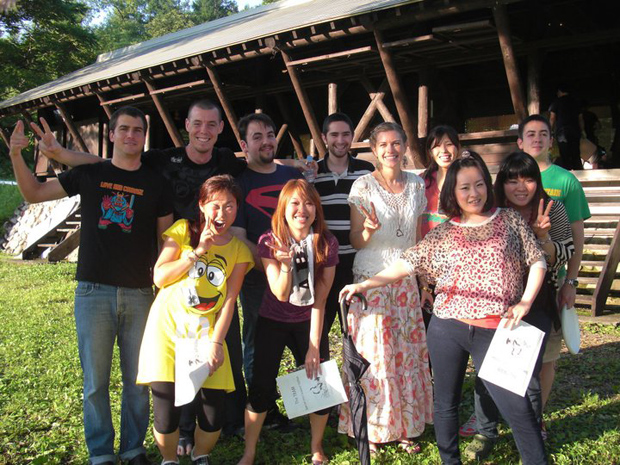 A lot of Asian people are smaller than you, did you ever come across any stories about being a bigger than a lot of people there?
On my first day of school, I hit my head on the door, just walking into a classroom. That was embarrassing. Similarly buying a car. In Japan there are two classes of cars. The yellow plate, which is a good deal smaller than our cars, and that’s what I got because they are so much cheaper than the white plate cars which are like ours. But, just sort of fitting into one was kind of tough, they are basically go-karts with more solid car bodies around them.
You commented on people in Japan being homogenous, and I have heard of this Japanese proverb, which is, “The nail that sticks up is the one that gets pounded down.” It seems like a very conformist society. What is is like being so different in such a conformist society?
There is a sort of guided privilege that you’re not expected to have to conform as much, possibly because they don’t think you are able to. But, like I said, you are definitely noticed all the time. I even noticed it for some of my students. We had one kid who’s parents had named him Elvis, and it’s a hard name to pronounce in Japanese. But because he had such an unusual name, even though he was Japanese kid, he was always the one noticed by teachers. When they referenced him, it would always be “Elvis and his friends” when some kids were in trouble.
You said you left after three years because you were sick of people being so different…
Well, I always wanted to come back to America but that was definitely a contributing factor.
When did you start wanting to come back? Was it after your first day, or was it slowly just missing home?
I mean there were things that I missed about America and I think that going to a different country really makes you appreciate things about the place you were in. I think if you have never been anywhere before, it’s really hard to see some of the greatest things about it. It had always been my plan to stay two or three years, and then come back. But yes, kind of gradually the urge to come back did grow stronger.
Would you go back to Japan, and if so would it be just to visit or to live there?
Just to visit, I think. I really enjoyed the teaching in Japan, but I think in the most part it’s in the past for me.
What was the biggest cultural difference from here to Japan?
I think we kind of hit on this, which is Japanese culture has a disposition towards a sort of group mentality, they think more towards the group good than we do. Where as America sort of celebrates the idea of the individual more.
When you go to a new country, you obviously experience a sort of culture shock, just it being so different than where you were before, but when you got back to America after Japan, was there any sense of reverse culture shock, or was it just stepping into your groove again?
It wasn’t too bad. The first time I went to a restaurant, being back in America, having a waitress call me “hun,” and getting this huge, huge portion of food. It was a little shocking.
What would you say was the biggest shock coming back to America? Something you might have forgotten about, or something that is really different?
Probably just how much things had changed. Between college and Japan, I had been away from Portland for the best part of seven years, and just seeing things like new buildings pop up, or sort of just upswing in the amount of food carts. Just little things like that.
So, you were planning to come back to Portland after Japan?
Yes, I love Portland.
What was your plan to continue forward after you got back from Japan?
I didn’t really have a clear one, actually. I learned that I really enjoyed education, and I’d still like to pursue that ultimately.
What years were you in Japan?
From 2009 to 2012.
So you were there during the big earthquake. Did you experience the Fukushima earthquake? Where you were?
Yes, so Toyama-ken is very much like Oregon, in the way that you can feel the earthquakes, but you’re never going to really be affected by them. Things are never going to fall off your shelves. But yeah, I felt the earthquake. I was in the teachers’ office, at first I thought there was was something messed up with my chair, that it was wobbling or something, then I realized that all the blinds were moving back and forth as well.
Did you know that the earthquake was going to happen before it did?
No, not at all.
Once you realized that it was an earthquake, was there a sense of fear that something bad was going to happen?
No, not really, the shaking wasn’t very bad where I was.
When did you first hear about the devastation that did happen on the other side of Japan?
Almost immediately when I got home. I did flip on the news, just because I had been hearing things from teachers, whispers, little rumors. That was when I heard about the nuclear plant going up. That was a little scary, admittedly.
What was it like the following days, weeks, months after the earthquake? How did your prefecture, Toyama-ken react to the earthquake and nuclear plant?
Honestly, so my prefecture was pretty much unaffected. The only really visual effect was the convenience store shelves were a little barer. There was a sort of grim, a sort of black humor actually, that my fellow co-workers were employing. The oddest thing was the disparity between the Japanese and American news. I kept hearing things from American news sources that essentially everyone was going to die from radiation, everything was horrible. My family kept emailing me every hour. Yet according to Japanese news, everything was fine, nothing was wrong. Really, of course, the truth fell somewhere in the middle.
How do you think that the Japanese people’s reaction was different than American people’s reactions if it had happened here?
I certainly think that the American response would have been more reactionary. That being said, it might have caused even more timely action. The Japanese government is fairly corrupt in the sense of setting up things. Well, whether our government is better is up for your readers to decide.
I am going to bring this back to teaching and the JET program. Obviously, Northwest Academy is very different from even other schools here in Portland and the United States, but how different were the schools in Japan from the schools here?
Most of my schools had uniforms, despite being a public school, they had uniforms in Japan. The culture was very different. I taught at five different schools total. Four elementary and one middle. My most rural elementary school was actually really great, more like a private school, more like a Northwest Academy environment, just by nature of being smaller, with class sizes and things like that.
You were there for three years but taught at five schools. Why so many?
I rotated throughout the week, they didn’t have an English class every day.
Were the kids as invested in their education as they are here, or even China as an opposing Asian culture?
No, I would say they certainly weren’t as involved in our education as our sort of stereotypes of Asians as Americans.
Do you feel like you made a difference to any students in Japan?
I know, yes. For at least a few students, at least.
Before your first day of teaching, what were you feeling?
Oh, it was nerve-racking. The first day, I almost hit a kid with my car. It was one of my students. You know just a great day. I don’t know, I didn’t really know what to expect
Related Posts


About The Author

Sam Crispin
Sam Crispin is a 10th grader at Northwest Academy. This is his second year in the school iJournalism class. His soul is as deep as a calm ocean, but as beautiful as a soft summer breeze blowing a flower down a stream.