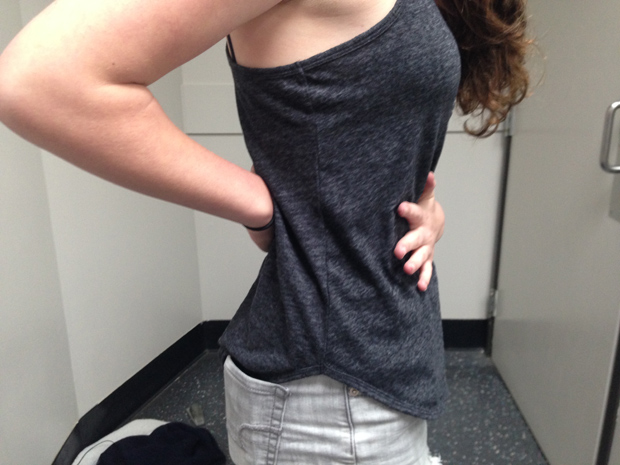
We all know those girls. The one who doesn’t fill her size zero pants saying she needs to lose 15 pounds. The one who mysteriously slips into the bathroom after lunch everyday, popping a piece of gum in her mouth as she heads off to her next class, her ribs jutting out of her tank top. The one who recites the calories of the foods on her lunch tray, feeling bad about it before she’s even started eating.
And we find ourselves sitting across from her in our baggy sweatshirts while guzzling down a cupcake, wondering why she does this. Is she trying to make us feel bad? You ask her if she wants a bit of your mac and cheese, but she declines, saying she’s eaten too much already. What a bitch.
It’s obviously a surface thing, right? She’s just taking the whole look-like-the-model-in-the-magazine thing too far, competing for the slimmest waist like she’ll win a prize at the end. It’s just a phenotypical obsession.
When I was in sixth grade, I was in the all-school musical, “The Wizard of Oz.” I was a poppy, and for one part of the production we stood backstage and sang a haunting little chorus. Since there was acting going on while we sang, in rehearsals we often stood there with nothing to do as they worked out onstage problems. Another girl in the cast who was my age had an older sister in the same grade as my older sister. She asked me if it was true that my sister had become vegetarian. I said it was.
“It’s only so she can eat less food, you know,” the girl said to me.
I immediately filled with rage. Was she insinuating that my sister was some anorexic?
“No!” I said, quickly defending my sister. “It’s because they watched that movie, “Food, Inc.” in health class. She was disgusted by where some meat comes from. That’s why she’s vegetarian.”
Yet not even a year later, my sister was put into intensive treatment for a combination of anorexia and bulimia.
The complex world of eating disorders is much deeper than its appearance. Numerous psychological, interpersonal, social and biological factors come into play, resulting in inadequate nutrition and sickening body image distortion. At the core, an eating disorder is an outlet for stress and a way to gain back control. Most commonly, a patient will have a disrupted home life, for instance a sickness in the family or parental pressure to do well in school (National Eating Disorders Association).
An eating disorder allows a patient to govern their nutrition when they feel they cannot control anything else. The pressures to be better and more appealing manifest in an intense desire to be skinny and pretty and a corresponding hatred of the way they are. It is, quite frankly, an unhealthy expression of pain.
However, the predominant societal view of eating disorders is one of shame and disgust. Eating disorder patients are seen as girls obsessed with being skinny who shame others for their weight. In reality, eating disorder patients usually see others as skinnier than them and feel fat compared to others. Patients who often just want to fit in are trapped in a world where, no matter what they do, they stand out.
As time has passed, the culture around eating disorders has gotten better. In some schools, students are educated about self-esteem and body image, as well as the signs and symptoms of eating disorders. However, mainstream media still praises flat stomachs and skinny waists in models and actresses, and the age of Photoshop has created images of women that are not healthy and girls could not possibly replicate. Only when we stand up against the mainstream media for our children and their right to love themselves for exactly who they are, as well as sympathizing with the pressures that surround them can we come closer to ensuring a safe and healthy future for them.
Children growing up today are faced with bleak statistics. The average high school student currently has the same anxiety levels as psychiatric patients in the 1950s. 44% of girls and 15% of boys in high school are attempting to lose weight. Anxiety and depression are strongly correlated to, though do not necessarily cause, eating disorders, and up to 24 million people suffer from eating disorders in the U.S. alone. Only one out of every 10 people suffering from an eating disorder will get treatment. In surveys, most teens said they wish that their parents could communicate with them better.
Even today, my sister almost totally in remission from her eating disorder, I ask myself why I felt the need to starkly defend her when she was accused of having an eating disorder. Why was it so shameful? Why did I regard it as such? What was so gut-wrenchingly bad about being afflicted with such a disorder?
Lately, my guilty pleasure TV show, “The Bachelorette,”started a new season. I watch TV shows on Hulu Plus and the website puts cover photos for the shows on the shows’ pages. The cover photo for “The Bachelorette” was a big photo of this season’s Bachelorette, Andi Dorfman. The photo was Photoshopped heavily. There were no wrinkles on Dorfman’s face, nor pimples, eye bags or any spot at all. Her fingernails were perfectly shiny and her lips were perfect and glossy. Her neck was slim and there wasn’t a hair out of place on her head.
With this image of the perfect woman, the colloquial Bachelorette in fact, how could girls think they would ever be good enough? No matter how much make up I put on or how much weight I lose, my face will always have acne scars, I will always make double chins when I laugh, and my hair will never be flawless.
These are societal views of women are not permanent. This century alone has seen immense societal changes, from desegregation to women’s right to gay rights. It has been proven time and time again that a group of people can really change help to change the whole. If we could only take back our bodies and the way the media portrays them and promote healthy relationships with the way we look, we could save generations of girls and boys from the shame, guilt and turmoil caused by eating disorders.
So get mad. Be furious at companies and other medias that prey on insecurity and support unhealthy self-images. Tweet about it. Facebook about it. Blog about it. Tell everyone you know. Yell into the void. Because enough people yelling is bound to make some noise.
On Girls and Their Food
We all know those girls. The one who doesn’t fill her size zero pants saying she needs to lose 15 pounds. The one who mysteriously slips into the bathroom after lunch everyday, popping a piece of gum in her mouth as she heads off to her next class, her ribs jutting out of her tank top. The one who recites the calories of the foods on her lunch tray, feeling bad about it before she’s even started eating.
And we find ourselves sitting across from her in our baggy sweatshirts while guzzling down a cupcake, wondering why she does this. Is she trying to make us feel bad? You ask her if she wants a bit of your mac and cheese, but she declines, saying she’s eaten too much already. What a bitch.
It’s obviously a surface thing, right? She’s just taking the whole look-like-the-model-in-the-magazine thing too far, competing for the slimmest waist like she’ll win a prize at the end. It’s just a phenotypical obsession.
When I was in sixth grade, I was in the all-school musical, “The Wizard of Oz.” I was a poppy, and for one part of the production we stood backstage and sang a haunting little chorus. Since there was acting going on while we sang, in rehearsals we often stood there with nothing to do as they worked out onstage problems. Another girl in the cast who was my age had an older sister in the same grade as my older sister. She asked me if it was true that my sister had become vegetarian. I said it was.
“It’s only so she can eat less food, you know,” the girl said to me.
I immediately filled with rage. Was she insinuating that my sister was some anorexic?
“No!” I said, quickly defending my sister. “It’s because they watched that movie, “Food, Inc.” in health class. She was disgusted by where some meat comes from. That’s why she’s vegetarian.”
Yet not even a year later, my sister was put into intensive treatment for a combination of anorexia and bulimia.
The complex world of eating disorders is much deeper than its appearance. Numerous psychological, interpersonal, social and biological factors come into play, resulting in inadequate nutrition and sickening body image distortion. At the core, an eating disorder is an outlet for stress and a way to gain back control. Most commonly, a patient will have a disrupted home life, for instance a sickness in the family or parental pressure to do well in school (National Eating Disorders Association).
An eating disorder allows a patient to govern their nutrition when they feel they cannot control anything else. The pressures to be better and more appealing manifest in an intense desire to be skinny and pretty and a corresponding hatred of the way they are. It is, quite frankly, an unhealthy expression of pain.
However, the predominant societal view of eating disorders is one of shame and disgust. Eating disorder patients are seen as girls obsessed with being skinny who shame others for their weight. In reality, eating disorder patients usually see others as skinnier than them and feel fat compared to others. Patients who often just want to fit in are trapped in a world where, no matter what they do, they stand out.
As time has passed, the culture around eating disorders has gotten better. In some schools, students are educated about self-esteem and body image, as well as the signs and symptoms of eating disorders. However, mainstream media still praises flat stomachs and skinny waists in models and actresses, and the age of Photoshop has created images of women that are not healthy and girls could not possibly replicate. Only when we stand up against the mainstream media for our children and their right to love themselves for exactly who they are, as well as sympathizing with the pressures that surround them can we come closer to ensuring a safe and healthy future for them.
Children growing up today are faced with bleak statistics. The average high school student currently has the same anxiety levels as psychiatric patients in the 1950s. 44% of girls and 15% of boys in high school are attempting to lose weight. Anxiety and depression are strongly correlated to, though do not necessarily cause, eating disorders, and up to 24 million people suffer from eating disorders in the U.S. alone. Only one out of every 10 people suffering from an eating disorder will get treatment. In surveys, most teens said they wish that their parents could communicate with them better.
Even today, my sister almost totally in remission from her eating disorder, I ask myself why I felt the need to starkly defend her when she was accused of having an eating disorder. Why was it so shameful? Why did I regard it as such? What was so gut-wrenchingly bad about being afflicted with such a disorder?
Lately, my guilty pleasure TV show, “The Bachelorette,”started a new season. I watch TV shows on Hulu Plus and the website puts cover photos for the shows on the shows’ pages. The cover photo for “The Bachelorette” was a big photo of this season’s Bachelorette, Andi Dorfman. The photo was Photoshopped heavily. There were no wrinkles on Dorfman’s face, nor pimples, eye bags or any spot at all. Her fingernails were perfectly shiny and her lips were perfect and glossy. Her neck was slim and there wasn’t a hair out of place on her head.
With this image of the perfect woman, the colloquial Bachelorette in fact, how could girls think they would ever be good enough? No matter how much make up I put on or how much weight I lose, my face will always have acne scars, I will always make double chins when I laugh, and my hair will never be flawless.
These are societal views of women are not permanent. This century alone has seen immense societal changes, from desegregation to women’s right to gay rights. It has been proven time and time again that a group of people can really change help to change the whole. If we could only take back our bodies and the way the media portrays them and promote healthy relationships with the way we look, we could save generations of girls and boys from the shame, guilt and turmoil caused by eating disorders.
So get mad. Be furious at companies and other medias that prey on insecurity and support unhealthy self-images. Tweet about it. Facebook about it. Blog about it. Tell everyone you know. Yell into the void. Because enough people yelling is bound to make some noise.
Related Posts
About The Author
Kylie Stanion
This is Kylie's first year in a journalism class. Along with writing, Kylie is an avid clarinetist, playing with two of the Metropolitan Youth Symphony's top groups. She enjoys reading and drawing in her free time.