Rolling The Dice With David Wagstaff
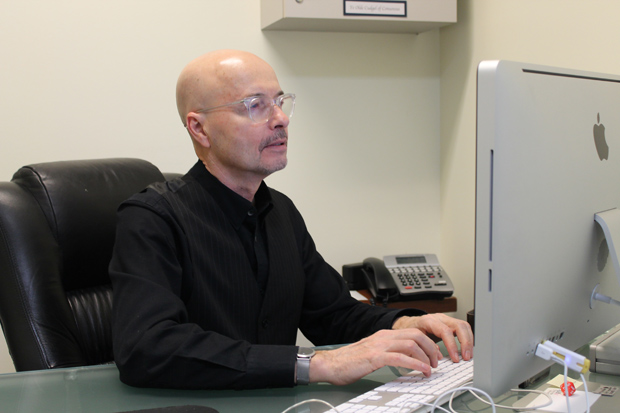 During high school, David Wagstaff had an English teacher who did not like him. One day, Wagstaff stood up to read his original poem, “Ode to the Hells Angels.” After reciting its opening line, “Drinking and raping they ride,” his teacher kicked him out of class.
“When I came back into the class, the girl behind me asked me if she could have the copy of ‘Ode to the Hells Angels’ and if I would autograph it because she thought I would be famous one day,” Wagstaff said. “And, I thought, hmmm, now I know for sure what I want to be.”
That was the moment Wagstaff realized he wanted to become a writer.
Writing has followed Wagstaff throughout his life, whether he is playing in a band, teaching or disciplining students in his current job as Dean of Students at Northwest Academy in Portland, OR.
When I walked into Wagstaff’s office to do the interview, I did not know what to expect. Among students, he has a reputation for being unpredictable. He had me roll an eight-sided die. I rolled a six.
“When you roll the dice, an even number is yin, and an odd number is yang,” Wagstaff said. “Odd is active, more assertive, more aggressive. Yin is more receptive and slower but wider and deeper.”
I took that as a sign the interview would go well.
With expressive hand gestures, Wagstaff described his college years and how his first “very bad movies” were made. He studied screenplay writing at the California Arts Institute in the 1970s and began to develop a surreal style of comedy writing.
“I think that I start out writing dramas but inevitably humor creeps in,” he said.
One of his screenplays was called “Alien Love,” a film about an alien who crashes onto earth and falls in love with women, and after 24 hours, they explode. The first long script he wrote was entitled “Burgers from Heaven.” In it, people from outer space appear in the sky floating in a giant hamburger as they came down to earth.
“I would write scripts, and my friends and I would shoot them,” he said. “I know every aspect of the movie business having done it poorly myself.”
As he scratches his bald head, he shifts to talking about his music career.
With his tall, lanky figure, it’s easy to imagine him on stage.
“I had friends who were musicians,” Wagstaff said. “Poetry was such a private experience for me, and this was an opportunity to make that public. A friend of mine was in a fairly famous band, and I gave him lyrics that his band used. Shortly after, I began my career as a singer-songwriter.”
For Wagstaff, the best part about becoming a musician was publicizing his writing.
“I love being on stage,” he said. “I never met a stage I didn’t like.”
His daily life often sparks new ideas for his writing, directions he can take new ideas in or ways he can re-work his older ideas.
“Something that I may see on the street can prompt me to think of a character that I had written in a play,” he said. “You have a kind of memory for these characters that kind of blends with other memories. If I wrote a certain type of person years ago, that person might be paired in a screenplay with someone who was from one of my stories. My writing has so much to do with memory.”
Wagstaff describes part of his writing process for songs, screenplays and stories as recycling and being able to use old writing to fuel new ideas.
“Somewhere I read that every writer has one story, and he works on it all his or her life,” he said. “I think that’s true. Your work tends to go in a similar vein because a person’s work tends to recycle things. You want to keep everything that you write and go back to it.”
Because Wagstaff works in music and in theater, an important part of being an artist for him is working collaboratively. He uses his resources and personal connections to find creative partners and get feedback on his writing.
One such person is his current screenwriting partner, John Parker, who lives in Los Angeles. Parker is an accomplished songwriter. Among others, he has written songs for Dolly Parton, Celine Dion and Sheena Easton. He has also written music for movies and TV shows and currently has his own recording studio in Los Angeles. Parker and Wagstaff have known each other for 20 years since they met in California, where Parker was leading a meditation seminar.
“Somebody brought David to my group,” Parker said. “Here’s this guy wearing a tie, and I think he looks like he is selling insurance, but he’s telling me he was in a rock band. I just could not figure him out. He had those glasses. He was just an oddball kind of guy, but he was into meditation, and so I taught him about it.”
The two stayed in touch, and when Parker had an idea for a screenplay but was not sure how to write it, he contacted Wagstaff to help him turn his idea into a story.
Parker enjoys their writing partnership and “Facetime meetings,” where they see each other and talk over their writing.
“We both feel that what is most important is the script and not whose idea it is,” Parker said. “The only way to collaborate is to let go of your own ego, and I think we balance each other because I have been making my living as a writer, while he is more reckless, an art for art’s sake kind of guy.”
Wagstaff’s writing coincides with every aspect of his life. He casts his students and co-workers in films and music videos. For example, Northwest Academy freshman Clio McCormick and dance teacher Erin Shannon had roles in Wagstaff’s music video called “The Walking Wounded.”
Not only have his family members been in his films, he’s even gotten his wife—Bijoli— thinking about going to film editing school at the Northwest Film Center.
“She’s very interested in editing, and she is very detailed orientated in a way I am not,” Wagstaff said. “I am detailed orientated in that I like to eliminate as many details as possible, but I do not like to labor over them.”
Wagstaff has brought his love of writing to Northwest Academy classrooms. For a few years, he taught a screenwriting class. It was a yearlong class where students were told to write their first feature-length screenplay. It had to be between 90 and 100 pages; if the screenplay was not at least 90 pages by the end of the year, you failed the class.
While this sounds harsh, Wagstaff says that an important aspect of writing is not to let doubt stop a person from their work.
“Sometimes, I’ll make adjustments, but in film, you have the wonderful ability to edit things out,” he said. “That’s not so true on the stage, but you always have to be careful about your edits. One day you may listen to the actor on stage or on screen and think you’re a freaking genius, but another day you might reread it and decide it’s horrible. To keep writing and trying things, you have to learn to detach yourself.”
While Wagstaff doesn’t always know what his next writing project will be, he never doubts that there will be a next project.
“My best quality as a writer and artist is that I have unlimited ideas,” he said. “One of the first things I ever wrote was a song in second grade about chewing gum. Since then, writing is as natural to me as breathing air.”
Related Posts


About The Author

Sarah Duran
This is Sarah Duran’s first year in a journalism class. Along with writing Sarah also enjoys playing sports and traveling, her favorite destination she has traveled to is Paris. She enjoys going to Hood River with her parents and being able to live in a city and a small town. Sarah hopes to continue writing and further engage in the world of journalism.