Life in the UFC
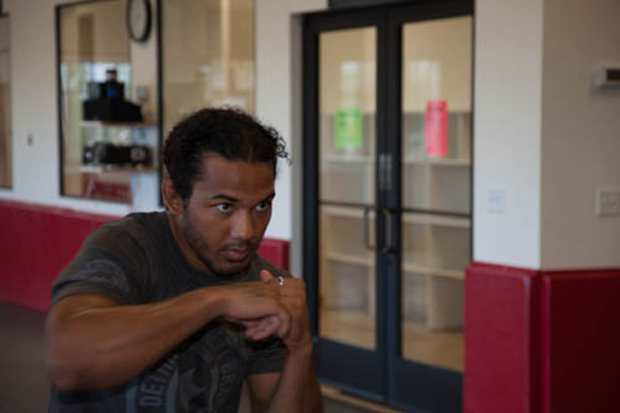 (Photos: Dan Swinmurn)
Slam. Into the wall, an arm around his neck. With three minutes left in the third round and a lightweight championship on the line, it’s time to make a drastic move. Ben Henderson tucks his arm around Jamie Varner’s neck and hooks his leg around his waist. To the spectators it looks like Henderson is about to hit the floor again, but he surprises everyone. His second leg comes up around Varner’s waist and his arms tighten around his neck folding the man in half. It takes about five seconds for the pressure to become too much for the fighter and he taps out. At two minutes 41 seconds into the third round Henderson wins by tap out submission with a guillotine choke. The lightweight championship, as well as $33,000, is his.
“My favorite technique is the winning one,” Henderson said. “Whichever one gets me a hand raised, that’s what I’m going for.”
The fighter, an avid comic book collector, started traditional Taekwondo at an early age when his mother, Song, insisted so he could learn more about his Korean heritage and culture. He first started fighting in the ring when he graduated college in 2006 with a double major in criminal justice and sociology. The 5-foot-9-inch, 30-year-old champion has never taken a sip of alcohol or a puff of any drug, choosing instead to place his faith and success in God. The devoted Christian raises his angel wing tattooed arms and gives dedicates his victory to Christ after each of his fights.
“I can do all things through Christ who strengthens me,” Henderson said.
In a comic book store before his title- defending fight, Henderson moves to pick up his books from the box kept waiting for him.
“When I was a kid we stayed home a lot during the summer and I would end up at the library in front of the comic book section,” Henderson said. “The Phoenix is back! I mean you guys probably have no idea what that means but it’s a pretty big deal in the Marvel Universe.”
It is hard to picture the man curled up behind the bookshelves of the comic book store fighting his way to the top of the Ultimate Fighting Championship (UFC) food chain. However, as soon as Henderson enters the ring he is a force to be reckoned with.
“It’s like with science fiction,” Henderson explains. “In 20-30 years it will all be science fact. It’s the same in the UFC. All this stuff is fantasy, it can’t really happen. And then you have guys who go out there and are phenomenal athletes and they make it into a fact!”
Henderson gives his fellow fighters superhero alter egos as a way to analyze their fighting styles. There is Spider-Man and Mr. Fantastic, for example. Describing himself as a quiet version of Shatterstar you start to see Henderson’s own twin appear. The man trained from birth to be a warrior, a fighter and put on a good show.
As Henderson, twice named National Association of Intercollegiate Athletics All-American, moved from Taekwondo to wrestling to pro fighting he steadily grew in skill and diversity.
“I realized I wanted to be a fighter when I won my first fight,” Henderson said. “I realized it felt good and I kind of liked it, so I wanted to see how far I could take it. I wanted something where I could use my background in wrestling and maybe make some money to pay the bills.”
Three short months after Henderson turned pro he made his debut fight with World Extreme Cage (WEC) fighting before moving to the UFC in 2010 when the organizations merged.
Since his first fight, Henderson wanted to be the man with the belt and one of the best fighters in the world. As Henderson started planning ahead for his future, he saw his possibility of being lightweight champion growing. Now, eight years later, Henderson is fighting among the most successful fighters ever and has held the lightweight championship for both the WEC and the UFC.
***
The UFC has been gaining popularity since its start in 1993 in Denver, CO. It revolutionized the fighting industry and stands as one of the world’s leading Mixed Martial Arts (MMA) promoters. The UFC has spread across the world and is now broadcasted in 150 countries and 22 different languages.
While the UFC has been recently gaining popularity, MMA fighting has been around for a very long time. As a full contact mixed martial arts form, it combines many different forms and techniques of fighting, from wrestling to boxing to Taekwondo. The rise of the UFC has helped MMA become more popular and given people a better way to fight competitively.
Becoming a competitor for the UFC is the goal of many young up-and-coming athletes who seek a future in the world of MMA. Becoming a UFC fighter gives athletes the chance to hold a championship title and be rivaled among other champions as well as earning them a larger paycheck.
Being one of the most well-known and successful fighters has its perks. Henderson can win up to $78,000 a fight plus a $39,000 win bonus. Well-known UFC fighters can also pad their incomes with endorsement money from personal appearances and sponsorships. Henderson, for example, represents companies such as The Gun Store, BlueGrace and Phoenix International Raceway.
Even though there is the potential to earn a large sum of money with a career in the UFC, fighters are aware that there is a fairly small window of opportunity to fight with the big name organizations and all of their income could vanish if they get injured or lose their ability to fight. Because the UFC is such a competitive industry a career can be over before it really even starts and a championship title can be lost in a matter of weeks.
Henderson has worked hard to rise through the ranks and establish a semi-stable profession while being careful to save and budget all income.
“I think that any of the money you earn from fights and sponsorships should go into savings and then anything else made on the side can be used for things like vacations and cars,” Henderson said.
While Henderson is among the group of fighters who can make millions there are still the people who are rising through the ranks to reach the title goal.
***
 Conor McGregor, a rising UFC fighter from Ireland, entered the MMA scene when he was 18 and won his first UFC fight in 67 seconds. McGregor taught himself self-defense from a very young age and has been growing stronger and more popular as he gets older.
“Self defense was something that took up most of my thoughts at a young age after I was beat up by an older kid,” McGregor said. “I eventually joined kickboxing, then boxing, then I found MMA. An obsession took over me, and that is an understatement.”
As the Irishman poses on a boulder for a photo-shoot it isn’t hard to see what makes him a formidable opponent. Despite his bulging muscles, McGregor’s mustache socks, natural smile and thick Irish drawl belie the violence of his profession. However, he’s unpredictable in the ring, not allowing his opponents to second guess him for a minute.
“I don’t react, I create,” McGregor said. “I don’t think, I visualize. I don’t watch, I study.”
As with many popular athletes people either love McGregor or love to hate him. However, as he walked out in the Octagon for a preliminary fight against Max Halloway to the song “I’m Shipping up to Boston” by Dropkick Murphys with an Irish flag slung around his shoulders, it was clear who the crowd was cheering for. His cocky and laid back attitude towards the whole thing quickly makes him a fan favorite.
At age 25, McGregor’s skills are undeniable but they aren’t the only things making him memorable. It’s what he says.
In a previous post-fight interview McGregor stated, “I know nothing about rugby, I know nothing about American sports. But I’m an expert in human movement, and I’ve got a PhD in unarmed combat.”
While McGregor has only been fighting in the UFC for a about a year he has already made a name for himself as one of Ireland’s most famous athletes, being the first professional Irish fighter to have two world titles in two separate divisions and being the focus of a documentary “The Rise of Conor McGregor” by Raidió Teilifís Éireann.
As McGregor is climbing the ladder, his paychecks are getting bigger and he is earning more income from appearances and sponsorships. McGregor is known not only for his skill and personality but also for his rags to riches story. Just a week before his first fight he was cashing in welfare checks and saying that he should be coming into money soon. His first fight won him $60,000 in official earnings not including any bonuses.
***
The financial side of the MMA world is what can entice a fighter to sign with the UFC but it is also what can destroy a career. Fighters have said that it doesn’t matter who actually wins the fight, it matters how much they win. Josh Koscheck, a UFC fighter, said that one of the reasons for getting into the fighting was the chance to earn money from it.
“The money aspect made me want to go get into fighting,” Koscheck said, “My childhood was very blue collar. If I had $10 in my pocket I was rich. I was taught from a young age that the harder you work the luckier you get in life. I believe that if I was rich (or well off) as a kid I don’t think I would have made it as a fighter.”
Both Koscheck and McGregor ran into financial troubles when they were children, forcing them to work harder to make a living with their fighting.
“We had some tough times growing up money wise, but my parents had a work ethic that supported me and my two older sisters,” McGregor said.
Depending on the rank of a fighter, income can come from different places. For 41-year-old recently turned pro local fighter Jason Pittman, the majority of income comes from the gym he opened.
“I opened the gym as a second source of income,” Pittman said, “While I was making decent money off of the fights ($500-1,000 per fight), I wasn’t fighting enough to have a solid income so the gym came into being. I wanted someplace where I could be freer with my sport and my passion and let other people express that passion outside of the ring.”
The amount a fighter can win in a fight also depends on the size of the show.
“Fighter pay is not great at small shows,” Travis Trent, a soon to be pro local fighter, said. “$250 to show and $250 to win so you get $500 if you win as a pro. It all depends on the show; the bigger shows like UFC are where the money is. If you’re not there you’re not making much money.”
Amateur fighters cannot officially make money off of their fights so if they do make any earnings it comes from sponsorships or extra bonuses. Amateurs fight solely for the experience and the chance to become pro later. The popularity of a fighter can also affect their pay.
“It’s all about selling tickets,” Pittman says, “If you can sell a lot of tickets and bring in more people you are going to be paid more.”
For a well-known fighter such as Koscheck a single fight can win him millions. It all depends on marketing. To be able to make a steady income a fighter needs to be good as well as popular. Personal lives need to be set aside and all energy needs to be focused on improving if a fighter hopes to gain a title and really make it in the big time.
“Fighting is a way to provide for my life,” Koscheck said, “ You don’t have a personal life when you’re trying to become a champion. It’s hard to have both. In this game you could want to quit every day. You question yourself a lot in MMA. It’s one of the hardest sports on earth. It takes a toll physically and mentally on a person. But you have to keep fighting if you want to win.”
The fighter’s pay in the UFC is a subject currently under a lot of controversial debate. Many states and competitions have set amounts of money that a fighter can win. However, people find a way to get around that by providing extra bonuses like fight of the night, knockout of the night, and submission of the night. There are also the hidden secrets of locker room bonuses. While the official winnings of fighters are public information the locker room bonuses are where fighters can really make their money and it is all kept a secret. Sponsors will pay extra money under the table without the public’s knowledge. One of the first things every fighter learns is never talk about exact finances. While locker room bonuses are a fairly common knowledge among fighters if people found out about how much the fighters were really making the UFC would be forced to end the extra bonuses, which help support the fighters.
Marketing plays a huge part in the UFC world. There are clothing companies and sports drinks and gyms dedicated to groups of fighters, such as Tapout, which can allow them to become more popular in the industry.
Being marketed can help boost popularity leading to a better success rate. However, the real success lies in the ring.
“Being a fighter is your career,” Henderson said, “Being successful in your fight means being successful in your career and for a fighter, or any athlete for that matter, being at the highest rank you can be keeps you in a job.”
While being a professional fighter can have its pay offs, it is also important to have back-up plans and jobs set aside for a possible future without fighting.
“I know that if I ever stop fighting I will have my gym to work with, so I never have to worry about being out of job,” Pittman said.
While many of the big name fighters started their careers before college, there are the people that took the time to get a degree before making fighting their number one goal.
“If I weren’t a fighter I would probably be using my degree to be a police officer in Omaha,” Henderson said.
A fighter’s career can be over in matter of seconds. Whether it’s from loss of popularity, injury or age. While injuries are common among fighters such as broken bones or fractures, there are definitely injuries that could end a career for good. UFC fighter Anderson Silva broke his leg kicking his opponent during a title match. The kick shattered his shinbone, possibly ending his career.
“I never put thoughts of negative outcomes in my head,” McGregor said. “I try to keep a positive outlook on life and believe that no matter what happens everything works out. If you believe it, you will see it.”
McGregor is constantly filling his life, as well as his Twitter feed, with reminders to keep moving, keep setting goals, and keep improving.
“Set mini goals only,” McGregor said via Twitter. “Your long term goals should already be a reality. You already are who you think you are.”
Related Posts


About The Author

Kylie Swinmurn
This is Kylie's first year taking a Journalism course. Along with writing she is an avid reader, dancer and horseback rider. Kylie hopes to continue writing for The Pigeon Press and improve her skills in the upcoming years.