Botswana: Culture Shock
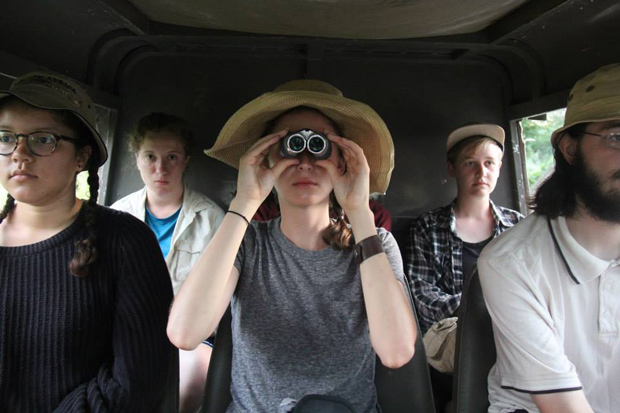
Some of the female exchange students sat in empty chairs. It was a lunch welcoming them to Serowe, Botswana, after all. A woman in charge of the event quickly rushed the girls out of the chairs, saying that they must sit on the floor because the chairs were reserved for men. By sitting on the ground, women remain socially and physically below men in Botswana.
“Both genders experience strict expectations and are confined to a narrow path that is predetermined by your declared sex at birth,” Suriya Shrogen, an exchange student in Botswana, said. “However, these roles are not equal. These roles are predominantly focused around the woman serving and catering to the man’s needs.”
Botswana comes as somewhat of a culture shock to the group of exchange students from Pitzer College, a school that is very open to feminism and alternate sexualities. Summer Sturtevant, one of the exchange students, described Batswana (citizens of Botswana) women as “second-class citizens.”
“I was raised by a single mother who is a feminist, and very into it,” Shrogen said “ As an American-raised feminist, it is impossible for me to see (gender roles in Botswana) as anything but sexist.”
Along with strict gender roles in Botswana comes an intolerance towards anything but heterosexuality. Logan Barnes, an exchange student in Botswana, identifies as genderqueer, with the preferred pronoun of they/them, but this is not accepted in Botswana.
“Being read as a woman, I have to play the roles of daughter, sister, ma’am, etc.,” Barnes said. “I was well aware of having to fill these roles before I came here. I just never realized how much it would cause me to feel like I’ve lost my identity completely.”
Being conscious of this difference in gender perception and homophobia before leaving, there was something else about Botswana that intrigued these five girls. Morea Levin chose to go because she wanted to work with an organization that dealt with HIV or AIDS, and nearly 20% of Botswana’s population is HIV positive. It was the large population of elephants in Botswana that roped in animal-loving Barnes. Although the girls all came to Africa for different reasons and have been doing various internships, they have all run into the unequal gender roles that permeate Botswana.
Even though the girls have been learning to speak Setswana (the language of Botswana) since they arrived in Botswana at the beginning of January, Shrogen said that they do not have the language skill and are too scared to tell men that harass them in Botswana to go away.
“It is literally 24/7,” Sturtevant said. “For example, I’ll be whistled at, cat-called, harassed by men all day and then I have to come home and wash my father’s hands and serve him tea. It’s inescapable.”
Levin attended a wedding in Botswana, and said it was one of the most blatantly sexist experiences she has had.
“Her vows to repeat were different than his; hers were far more subservient and based around obeying her husband,” Levin said. “I think the hardest part about that section of the wedding was that while the pastor spoke about gender roles, other Batswana women around me were voicing approval/agreement.”
As Botswana has changed and become more metropolitan, the gender roles have remained predominantly the same, as they are deeply connected to Botswana’s culture and tradition. Historically, the males worked on the lands while the women took care of the households. The Kgosi, or central members of communities, are also traditionally men.
“Women were, for the most part, left to make their own decisions and control the way they lived their lives,” Shrogen said. “However, as the culture began to be more Westernized, the balance began to shift and women began to become more aware of the inequality.”
As Botswana became more urban, men gained new jobs closer to home.
“Then (the men) were also home more often, taking over what was previously a female dominated and controlled site,” Shrogen said. “The women are now expected to work for them, catering to their every need.”
As times change, some Batswana are ready for change as well. Both Shrogen and Barnes interviewed Batswana women about their gender roles. Most of the women that Barnes interviewed wished to keep traditional gender roles. However, many of the women that Shrogen interviewed were ready to change.
“While the women interviewed (for a research paper) seemed eager to change several aspects of the culture, the men, somewhat unsurprisingly, were not quite so fired up,” Shrogen said.
Many Batswana see the fact the there is a female Kgosi as growth away from traditional gender roles. But in Manyana, one of the villages that the exchange students spent time in, this progress is not so evident.
“Same Mangope, as the eldest child, is in line to become the Deputy Kgosi in Manyana,” Shrogen said. “As a law student at university in Gaborone, she is more than qualified to take over this position and would love to take it on. She thinks it is an extremely important job and wants the opportunity to serve and lead her community. However, the position will go to her 12 year old brother.”
If Same chose to not get married and keep her family name, she would have a chance of becoming the Kgosi. Even if Same chose to stay unwed and become Kgosi, she would not be a respected leader because of her single status. Shrogen says that the married rarely listen to the unmarried in Botswana.
“Women are constantly caught in a Catch-22 where society, and by extension men, demand them to fulfill contradictory roles, where it is impossible for them to come out on top,” Shrogen said.
The five exchange students have encountered sexism in America and in Botswana, but see more movement away from these gender roles in America. Barnes experiences much more freedom in the United States, especially to identify as genderqueer.
“While many issues surrounding gender may be especially prevalent in Botswana, they are certainly not exclusive,” Shrogen said. “These are issues that plague American culture as well. What is clearly lacking in Botswana, however, is the awareness and opportunity for women to not only realize their own power but fight to claim a position equal to men.”
Related Posts


About The Author

Isabel Downes-Le Guin
Isabel Downes-Le Guin is a senior in the Creative Non-Fiction class. Isabel is barely ready for college. She enjoys books and being sassy.