Three Northwest Academy Students Engaging in Independent Research
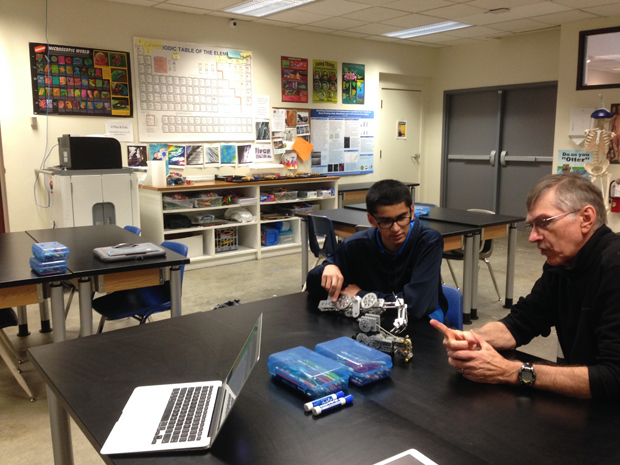 Three high school students are taking part in a brand-new, independent science research program.
The students earn academic science credit by conducting year-long science research projects. Molly Sultany, the high school science teacher, is the creator of this program.
“This is something that I’ve been wanting to do for a couple of years, and with generous funding, we were able to purchase the supplies and materials that would make this program a reality,” Sultany said.
The program became a reality after Sultany won multiple educator grants from the American Chemical Society and the Diack Ecology Education Program for her work on designing a science research experience for chemistry students.
“This allowed us to buy novel technologies,” Sultany said. “We have an Android tablet attached to a compound microscope; this scope can take photographs and measure objects in micrometers. We have micro-pipettors for DNA studies, a centrifuge, and incubator for bacterial cultures. These are some of the resources that we’re able to use for science classes.”
Jared Kerman, a senior, is working with the Wetlands Conservancy, a nonprofit organization, on assessing the Johnson Creek watershed’s stream health using diatoms, microscopic protists.
They evaluate the pollution in the streams by analyzing diatoms, a major type of algae, through a Scorecard analysis. This analysis tells them how pollution-tolerant the diatoms are, therefore showing how polluted the streams are.
Kerman first started researching diatom-based bioassessment of streams last year for a science project, contacting the Wetlands Conservancy organization at the Johnson Creek Watershed Conference at Reed College last spring. This meeting helped Kerman decide on a topic for the independent research project.
“I met an Urban Land Steward for the Wetlands Conservancy last year, when Katerina [Mon Belle] and I were presenting a poster our diatom-based bioassessment of stream health within the Johnson Creek Watershed and it was this meeting that allowed me to work with the Wetlands Conservancy this year,” Kerman said. “When it came time to choose a topic to research this year as a part of Northwest Academy’s novel Independent Research class, it was pretty clear to me that this project was the way to go.”
Kerman has been working extremely hard on the project, both in and outside of school. All of this hard work paid off though, as he received a grant through the Diack Family Oregon Ecology Education Program.
“This grant will fully fund my research in the upcoming year and it is so rewarding to have spent so long working on a grant document and having it accepted,” Kerman said. “Molly and I have both been hard at work on this research, and every day I am so excited to go to class to spend more time improving this project and carrying it out.”
**
Since the beginning of the school year, Sanjana Potnis, a junior, has been regularly conducting research on plant genomics at Portland State University. With the help of Professor Mitch Cruzan, Professor of Biology at PSU, Potnis was able to develop a research focus for her independent project: Brachypodium Sylvaticum.
Brachypodium Sylvaticum, or false brome for short, is a type of invasive bunchgrass native to Asia and Africa, but it is found in Oregon as well. Potnis will be using sophisticated microscopes to count leaf hair density on false brome plants to determine whether differences in leaf hair numbers are from phenotypic plasticity or natural selection.
“We all know about natural selection, which is an evolutionary process that occurs over generations and generations,” Potnis said. “Natural selection is simply a way that species of plants and animals can adapt to changing environmental conditions. But there is something that is not quite like natural selection, but it aims to do the same thing; acclimate to changing environment. This is something called phenotypic plasticity.”
While natural selection is something that happens over generations and changes the gene pool of a population itself, phenotypic plasticity is something that a single, individual plant can use to acclimate to a changing environment.
“For example, sometimes plants will grow more hairs when moved to an area with more sunlight in order to protect from the sun,” Potnis said. “This isn’t directly related to evolution, because that happens over a long time. This happens with one plant, right now!”
Potnis’ goal for the project is to figure out if these morphological (visible) differences are due to variation in the encoded genes of the plants themselves or due to the idea that these plants can individually adapt to changing environmental conditions due to global climate change.
***
Sushruta Chandramouli, a junior, originally came up with the idea of creating an artificial finger as his brother Kapila had been working on a similar project two years prior. He (Sushruta) has been working on the finger since the beginning of the year.
“My brother (Kapila), two years ago, he did a similar project involving a robotic finger,” Chandramouli said. “He came up with a design that used gears to move the finger, but the problem was that it couldn’t do the motions. So basically, I’m starting from scratch.”
The goal of Chandramouli’s biomedical engineering project is to develop a robotic finger that closely simulates the range of motion of the human finger, while reducing the number of power-consuming devices like motors, conserving resources and running for a longer time. He also wanted to improve his brother’s prototype, and his understanding of the use of robotics for bionics.
The joints are held by springs in position, controlled by a pulley system that moves the finger back and forth. Chandramouli is currently designing the prototype of the finger, and looks forward to meeting with a physics specialist at Vernier Software next month to measure the effectiveness of his designs.
Currently, the program is open to upperclassmen. Applications for project proposals are accepted in the spring of each school year. Sultany looks forward to growing this program.
“We’re really excited about the opportunity for students to conduct long term independent science research projects that allows them to explore a particular discipline, and to develop critical thinking and problem-solving skills in science,” Sultany said. “This offers a more in-depth opportunity then a one-day lab in a science class.”
Sultany is running a Google Classroom website for students who are interested in taking the class next year, with weekly assignments that structure the research process. Students also keep a research notebook, electronically, or by hand.
Related Posts


About The Author
Charlie Goddyn
Charlie Goddyn is a sophomore at Northwest Academy, with this being his second year in the iJournalism class. When he's not rushing to finish his articles, he enjoys playing keys and video games.