Osmanagich Visit Stirs Discussion
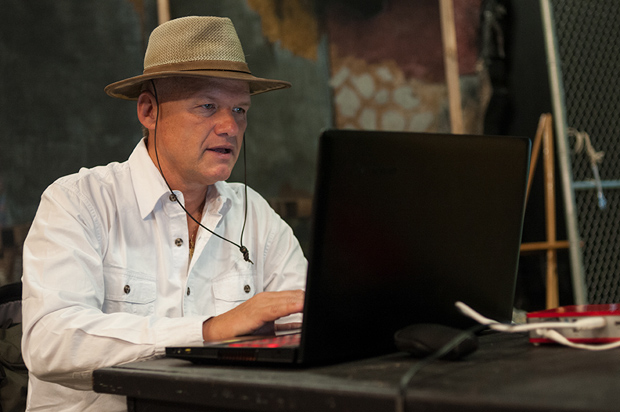 Archaeologist Sam Semir Osmanagich spoke at a lunch event last Friday, discussing his reported discovery of pyramids in Bosnia.
“Ultimately, that’s what my goal was: to have him come,” David Bliss, Technical Theater Director, said. “To make us all think a little, outside of books and the internet and television, and take a moment to see that there’s other sides to stuff. And I think he achieved that.”
Bliss played a major role in arranging Osmanagich’s visit to Northwest Academy. Bliss, an avid supporter of Osmanagich, had approached Mary Folberg, Head of School, to suggest that Osmanagich visit for a lunch event.
“In this case, the origin of this event was that Wade [Willis] is directing a play about Bosnia,” David Wagstaff, Dean of Students, said. “David Bliss was excited about this. He thought it would be interesting if in the same year that we’re doing the play we could have this guy come to speak. So I said, ‘Talk to Mary.’”
Wagstaff said Osmanagich’s visit was approved before his theories and the controversy surrounding them were fully understood.
“Only later did we realize that he was such a controversial figure in archaeology,” Wagstaff said. “So then the controversy began, you know, are we having weirdos come and speak? ‘Cause if you want weirdos, I’ve got them.”
Folberg was initially worried about the event. However, she now believes that the controversy surrounding Osmanagich’s visit is what made it worthwhile.
“I felt really bad at first, and then I thought, ‘Wait a minute–our kids are smart enough to think critically about what they see,’” Folberg said. “I’m really glad that it happened because I think it’s very important for the students. If we always bring in people that are super credible, you won’t learn to knit-pick and analyze. It’s important for us to encourage you to listen to people who may have credibility or may not and learn to sort things out for yourself.”
Willis, High School Theater and Music Instructor, agrees with Folberg.
“At the very least, [this lunch event] created discussion,” Willis said. “There is nothing better in an educational process than creating or finding opportunities to have discussions. When those discussions create multiple points-of-view and everyone doesn’t agree, it fosters deeper critical thinking, the key to being a great student.”
The lunch event certainly created discussion. Students and faculty have voiced a variety of reactions to Osmanagich’s presentation.
Bernard Cohen, a sophomore, said that he thought Osmanagich was inspiring.
“I actually really like a lot of the stuff he said,” Cohen said. “Maybe some of the stuff was a little outlandish, but I do like the idea of other civilizations knowing about energy healing and stuff like that.”
However, some students took a more skeptical stance, especially towards claims of healing tunnels and electromagnetic beams.
“It made more sense at the beginning, it was more plausible, but once he started getting into ‘auras’ and ‘electronegativity,’ I knew that he had not purely objective scientific motivations,” Braam Beresford, a junior, said.
The faculty also had a mixed response to the event. Folberg said she was not completely convinced by Osmanagich’s presentation.
“There was so much ‘I’ve proved, I’ve proved, I’ve proved,’” Folberg said. “Well, show us the money!”
Some of the faculty and student body were intrigued nonetheless.
“He does set forth a lot of his own proofs and research,” Wagstaff said. “We know that the pyramids [are] definitely there, they’re definitely not just mountains. But I think, as he indicated, much of what he does is speculation. Whether this man has the ultimate truth or not, I definitely think that he’s investigating something that should be investigated at length.”
After the presentation, students received only 13 minutes of question time.
“I was very interested in how he would give evidence to his theories and back up his opinions in what he was telling us,” Elle Biesemeyer, a sophomore, said. “But I feel like he evaded a lot of what we wanted to learn and a lot of questions that we asked.”
Katerina Mon Belle, a junior, believes that Osmanagich could have answered the students’ questions more politely.
“I think he handled [the questions] more rudely than he should have and it was very obvious in his demeanor that he has been hassled before, and he’s used to dealing with very rude people,” Mon Belle said. “Some students asked some questions that were kind of ridiculous, but for the most part, students were polite, yet he was very defensive.”
Richard Perrine, Math and Science Teacher, had a few questions that he would have liked to ask Osmanagich.
“I would have liked to have asked him if his desire to change Bosnia’s public image may have somehow tainted his need to make the pyramids more than it is,” Perrine said. “He spoke about how people are seeing Bosnia for the pyramids, something positive, and not only its war-torn history, etc.”
Wagstaff, along with much of the other faculty, was impressed by how students handled the short question period.
“I was very proud of the way Northwest Academy students comported themselves,” Wagstaff said. “There were a lot of people highly critical going in [to the lunch event], and they did bring up some issues, but they did it in a respectful and intelligent way. I think the response was overwhelmingly positive.”
Murray McClellan, a friend of a faculty member and former professor of archaeology at Boston University, expressed surprise that Osmanagich was invited to Northwest Academy.
“Perhaps we professional archaeologists have not done enough to denounce pyramidiots like Osmanagich, but this is a sign of a larger, anti-intellectual problem facing our world,” McClellan said. “It is a sign of how far we have fallen from the ideals of the Enlightenment that anyone in the 21st century could possibly believe in such scientifically impossible ideas. Questioning established scientific dogma is certainly necessary, and indeed is a crucial aspect of science itself; but to renounce the scientific method is taking us down the path to barbarism.”
Wagstaff disagreed, citing the common pattern of groundbreaking science being discredited by the general scientific community.
“In terms of his being renounced by traditional science I would say that humanity has a long record of renouncing people who go against what is the established truths of the day,” Wagstaff said. “Maybe everything he says is not true and proven yet, but I think that he’s definitely on to something, and I think that that is probably one of the reasons that the establishment of archaeology is protesting. Galileo syndrome could be in effect here. Not that I’m saying, ‘Hey, I believe it, I’m going to crawl into a tunnel and be healed.”
Osmanagich spoke about his claims in more detail during a longer presentation Friday night. The two-hour event was held at the Unitarian Church.
According to Bliss, the event was attended by approximately 40 people. Five or six of the attendees were affiliated with Northwest Academy and many of the others were from Bosnia.
“He gave a presentation that was a longer version of what we saw during the lunch event,” Willis said. “He is, obviously, very passionate about this project. At one point he called his work on the Bosnian Pyramids his destiny.”
Despite differing opinions, many agree that this was a provocative lunch event.
“There are some lunch events where I see people nodding off,” Wagstaff said. “This one, nobody was nodding off. Everybody came there with an idea, most people had questions in mind, and I think it was very stimulating.”
Reporting by Wyatt Alger and Gilian Foley
Related Posts


About The Author

Pigeon Press Staff
The Pigeon Press staff is committed to truth, justice, accuracy and the American way.