Controversial Scientist to Visit Northwest Academy
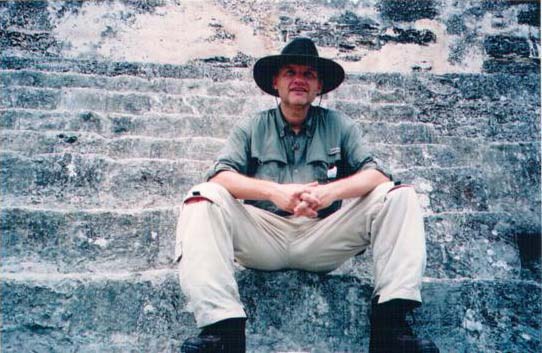 Tomorrow, archaeologist Sam Semir Osmanagich will discuss his controversial discovery of pyramids in Bosnia during a lunch event.
Osmanagich claims that a group of hills surrounding the town of Visoko, Bosnia is really a network of man-made tunnels and pyramids. He dubbed the area the “Bosnian Valley of the Pyramids.”
Osmanagich’s claims are truly extraordinary for a number of reasons. He believes that these pyramids were built approximately 12,000 years ago, during the Ice Age. If this is true, the Bosnian pyramids would be the oldest pyramids in the world, pre-dating the Egyptian pyramids by 7,000 years. They would also be the first known pyramids on the continent of Europe.
“In April 2005, I first traveled to the town of Visoko,” Osmanagich said. “My attention was caught by two irregularly shaped hills. For thousands of years locals have considered those hills to be a natural phenomenon because they were covered by one meter of soil and vegetation. However, when I first saw their triangular faces, obvious corners and orientation toward the cardinal points (east-west, north-south), I knew that they had to be constructed by intelligent hands.”
Dr. Osmanagich was invited to Northwest Academy by David Bliss, the technical theater director.
“My interest in pyramids took a more focused path about two years ago as I wanted to simply know more about them,” Bliss said. “What Dr. Osmanagich has to say directly affects each and every one of us. When you listen to him discuss what took place on this planet thousands of years ago you can’t help but be stunned by what his findings and research led to. A 50-minute lunch event isn’t really enough time to discuss it all.”
Osmanagich’s claims are controversial among scientists. In December of 2006, seven European archaeologists released a declaration denouncing the archaeologist’s findings. They called his research “…a cruel hoax on an unsuspecting public that has no place in the world of genuine science.”
“We’ve had opponents and difficulties since we started the excavation project,” Osmanagich said. “However, truth has been prevailing. What they have are the opinions, such as ‘it’s impossible to have pyramids in Bosnia,’ but they’ve never come with a single test, analysis or dating.”
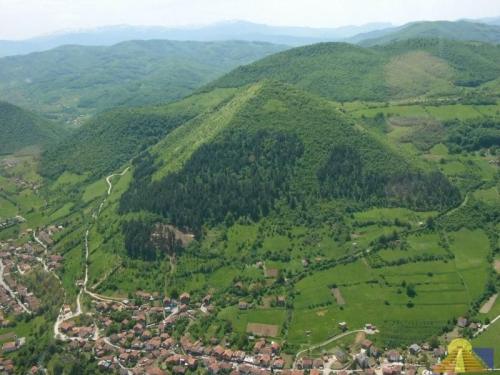 A 2009 Smithsonian magazine article titled, “The Mystery of Bosnia’s Ancient Pyramids,” said otherwise. According to author Colin Woodard, Osmanagich asked a team of geologists from the University of Tuzla to analyze core samples of the pyramid in early 2006.
According to Woodard, the area around Visoko has been quarried for centuries and is therefore well understood and geologically predictable. Geologists found that Osmanagich’s core samples matched the samples of other mountains in the area; they were composed of alternating layers of clay, sandstone and conglomerate, with no evidence to support Osmanagich’s theory of pyramids.
“[My critics’] opinions are irrelevant,” Osmanagich said. “Science needs scientific arguments. It’s true that some archaeologists in Egypt, Mexico, Germany or USA do not understand us today and try to laugh at us. Fifty years from now, people will be laughing at our mainstream scientists today and their lack of knowledge.”
Northwest Academy’s community has responded to this lunch event in various ways. Richard Perrine, a high school science and math teacher, is skeptical of Osmanagich’s claims.
“I have questions about his methods and the authenticity of the work that he’s doing,” Perrine said. “What is his professional qualification and training? How does the archaeological community and his peers view his research? I look at his research regarding the pyramids and past views and have to ask those questions.”
Bliss supports Osmanagich’s claims and is looking forward to the lunch event.
“What has been taught has now caused many to think that current findings, facts and research on the subject of pyramids is somehow considered ‘controversial’ or ‘quack’ science,” Bliss said. “The lunch event will have you thinking otherwise.”
According to Osmanagich, he and his team have been working continuously during the last nine years, spending over 360,000 hours in archaeological excavation, sample testing and radiocarbon dating.
He established a non-profit organization called Archaeological Park: Bosnian Pyramid of the Sun Foundation to raise funds for pursuing the excavation around the town of Visoko.
“Over the centuries, brilliant minds that had interesting theories or even good research were at times jailed, burnt at the stake, excommunicated or shunned by others,” Bliss said. “In my opinion, his work is certainly not ‘controversial’ but rather ‘refreshing, enlightening and simply makes sense.’ I couldn’t be more thrilled to have him share his findings with us here at the Northwest Academy.”
Osmanagich has a Ph.D. in Sociology of History, specifically The Mayan Civilization and a B.S. in Political Science and Economics. Both degrees are from the University of Sarajevo.
Osmanagich will be speaking in a longer lecture on Friday night at the First Unitarian Church from 8:00 to 10 p.m.
Reporting by Gilian Foley and Wyatt Alger
Related Posts


About The Author

Pigeon Press Staff
The Pigeon Press staff is committed to truth, justice, accuracy and the American way.
Well written. Very interesting subject, and gave the subject the necessary depth it deserved.
Bravo! I, before reading this article, was not interested in this topic. Hearing both sides of the argument makes me look forward to tomorrow!!!! Thanks.
how is this guy going to help educate us at all? we’re not really going to learn anything from this…
There are only 8,766 hours in a year; how could he have spent 360,000 hours on research in the past 9 years?
I think he was talking about the combined effort of his whole team.
Nice job, Gilly and Wyatt! Fair, thorough, and balanced. Now that Dr. Osmanagich has spoken at two school-sponsored events, I hope you write a follow up.