A Brief History of Esprit
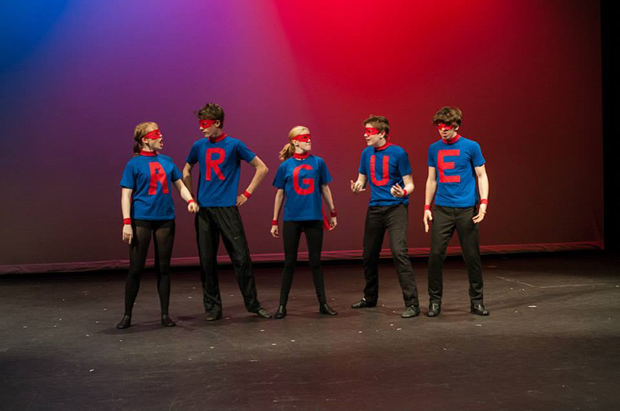 The lights went down on the stage, and the large screen came to life with images of students dressed as superheroes. Then, the 12 freshmen and sophomores that had appeared on the screen suddenly leaped onto the stage, dressed in full hero attire. The next five minutes consisted of an elaborate and highly creative dance choreographed by Erin Shannon, the dance and musical theatre teacher at Northwest Academy. This performance of “Superleague” was the opening for the 2014 Esprit.
The annual tradition of Esprit began in 1997, the year that Northwest Academy opened. It has been a major part the school’s culture ever since.
“We are an educational institution that values the partnership between arts and academics,” Wade Willis, Producer of Esprit, Arts Coordinator, theatre and vocal teacher said. “Because of this, as a staff, we feel that it is important to produce a showcase of all of the arts classes. In this way, not only do we, as a community, get to see, hear and experience all of the arts that are going on, but our students get to see what is going on in other classes as well. This might inspire students to try an art that they never would have thought of.”
Esprit is part of what is known as “Arts Week,” when all normal school classes are altered or removed in favor of gathering every performer so that the show can be put together and practiced as a whole. The rare students that do not partake in Esprit typically find themselves attending two to three person classes during this week, up until the matinee (daytime performance and sometimes shortened version), which non-participating students are allowed to attend during the last day of the performance.
Esprit is a showcase of every high school class’ work, so long as the work can be displayed on a stage. These classes range from black and white photography, to poetry, to musical theatre, to tai-chi. The different pieces are led and directed by a wide variety of teachers. Originally, Esprit was a compilation of both Middle School and High School performances, but this changed in 2012. That was the first year that the show was split into two counterparts, Dynamo for middle school, and Esprit for high school. This split has made Esprit far less exclusive, because it can now include more acts without running too long. It also keeps the show organized, both onstage and backstage.
In some previous years, Esprit had a storyline and specific theme. For example, Esprit 2011 featured a “carnival versus circus” theme. This tradition was scrapped in favor of creativity.
“Themes can, at times, enhance or drive the journey the audience goes on,” Willis said. “On the flip side it can inhibit the creativity and freedom of expression that can happen in each class. They both have their benefits. As we grow as a school, it becomes increasingly more difficult to have everyone teach their classes with a specific theme in mind.”
Even without having to worry about a specific theme, Esprit is already difficult to put together. It requires that numerous different groups perform together in a way that is organized and runs smoothly, which adds a whole new layer of challenges to the production, but also more payoff.
“For the high school band, performing for Esprit possessed many of the same qualities that performing at any formal chamber music concert would have,” Dr. John Savage, the band teacher at Northwest Academy, said. “I would say it was even more involved because of all the staging and intricate cues necessary for running the larger show.”
Because so many different groups have to come together to organize the show in such a short time, production of Esprit presents a number of unique challenges that other performances do not typically have.
“Esprit is an entirely different animal than other performances,” Willis said. “All of the work is done in the classes, separate from all of the other acts. Then in one day, we put all of the acts together and perform them. None of the acts are seen by the other (performers) until the first rehearsal.”
Head of School Mary Folberg has always found the extra work to be well worth the payoff.
“The most unbelievable feat is choreographing so many students at once, but the results are usually pure magic,” Folberg said about Esprit in an “OregonLive” article in 2011.
This year, all performances in Esprit were for actual classes, not counting the finale and the “Graduating Senior Compilation.” The latter replaced senior thesis readings in this year’s lineup. The “Compilation” featured Wilson Captein reading an original poem over soothing music and with the occasional dance interlude.
For the composition class, freshman Bernie Cohen played the piano to his chilling original song, “Motionless,” and freshman Kylie Stanion soothed the crowd with an original piece titled “Ballad for Solo Clarinet.” Other small yet standout performances included the High School Guitar class’ rendition of the Decemberists’ “June Hymn,” performed by the recurring star duet of Alex Ramiller and Ian Cummings. Sophomores Marisol Ceballos and Jared Kerman as well as junior Ilana Newman performed their award-winning pantomime “Moving On” for the Actors Workshop class, instructed by Willis.
Instructor Beth Federici’s film class met success with the crowd with their five submitted pieces, “Reading,” “Rejection,” “Henry,” “To the Max” and “The Box.” These student-made films were shown periodically throughout the show. Ben Sherman and Emerald Seale’s original film, “The Box,” brought the theme of horror to the show. Seale said that she was especially pleased with the reaction from the middle school students during the matinee.
“I heard about this one middle school kid, and he’s moving right now, and now he’s afraid of all the boxes,” Seale said.
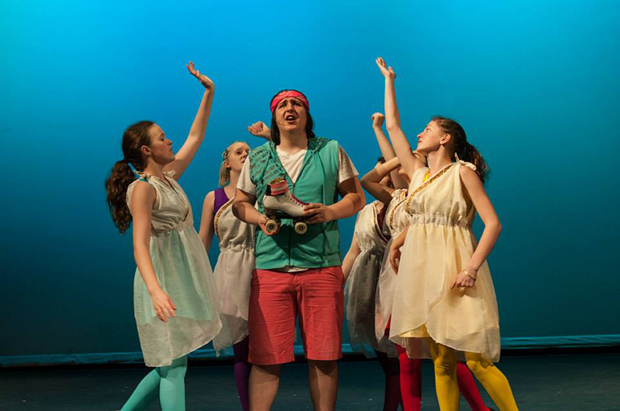 This year’s show also featured two songs from the recently performed musical “Xanadu” by leads Captein and Linnea Kelly.
“‘Xanadu’ is always fun to perform, even though one of the pieces was one I hadn’t previously had a singing part in,” Kelly, a junior, said. “The numbers are hardly ever perfect, because we’re singing and dancing and acting on roller skates, which is a little hellish, but never fails to be fun.”
Various dance performances kept the crowd on their toes. Shannon choreographed four pieces for her dance classes, not including the “Xanadu” pieces. Additionally, senior student and dancer Natalie Gullo choreographed an impressive dance to “Put It Where You Want It” with the advanced tap class. Guest instructors also choreographed work for the Intermediate dance class, which performed two brief samplers from a larger show.
The show was a strong and confident shift towards the end of the performing year at Northwest Academy. But not just Northwest Academy community turned out to watch Esprit.
“I think it’s really valuable to be able to display the art that our school does, both to our families and to the Portland community at large,” Kelly said.
Not new this year for Esprit was issues with the venue. In the past, issues such as lack of seating, small stage and problematic back-stage setup have stymied both performers and audience members. This year, the World Trade Center was intended to be a refreshing start, but ended up suffering from a variety of new problems.
“I didn’t really like the venue,” Ryan Richter, a freshman, said. “I mean it seemed like it wasn’t really made to be a theater.”
As with previous Esprit shows, commotion backstage was also an issue.
“We were mostly cooped up in a windowless room, which made people pretty on edge after a while,” Kelly said. “Overall, I think we should be more focused backstage.”
Some students, however, were able to cope with the familiar backstage environment.
“Backstage was a working system,” Sam Gullo, a freshman, said. “It got clogged every now and then because of people not moving fast enough to get out of the way, but other than that it was pretty clear. Previous years are very similar but it seemed that it was better than before.”
However, transitioning from backstage to onstage was reportedly smoother than in previous years.
“One of the biggest benefits of the World Trade Center was the rooms that we used as green rooms,” Willis said. “They were far enough away from the auditorium where we didn’t have to worry about sound contamination but close enough that the student/performers could get to the stage with ease.”
Additionally, like in past years, some of the performers and a handful of the involved crew said they feel as if there was not enough time to prepare for the annual show. This year, only one full day was allotted to the high school students for practicing. Prior to the practice, many of the performers had not worked together, collaborated with the tech crew, or even explored the venue. The result was that backstage felt chaotic and rushed as usual.
“There are so many logistical challenges during arts week, that the more we can anticipate and address, the smoother the week goes,” Willis said. “This year was one of the most organized years we have had.”
Contrary to the events backstage, tech operations went smoothly for freshman light board operator Robert ‘Pearce’ Hyatt and senior sound board operator Justin Monti.
“We only made it through the show once before,” Hyatt said. “I was impressed with everyone’s ability to be mature and professional. No one missed an entrance or came on missing a prop. For the time we had, it was an amazing first night.”
The tech equipment was reportedly easy to work with and very impressive.
“The World Trade Center is state of the art,” Hyatt said. “It’s quite impressive, not to mention the light booth feels like the bridge of the Enterprise from ‘Star Trek.’”
The show brought a lot of new content to the running history of Esprit. As Hyatt put it, “(In the past) Dynamo has had more of the silly ‘fun’ acts and Esprit has been more ‘artsy,’” But that this year’s Esprit had “a better balance between fun and artistic expression.”
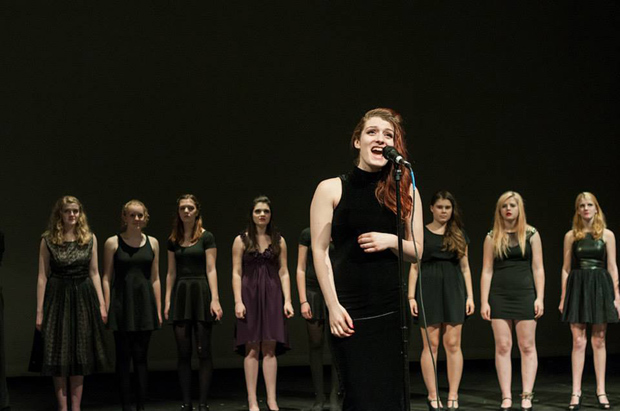 Unlike previous years, only teacher-submitted acts were allowed in the show.
“All of the performances in Esprit this year, except (Graduating Senior Compilation), came directly from the work being done in classes,” Willis said. “The students rehearsed every class period after their last performance, most of them performed in Club Cabaret last, toward their Esprit Performance. The one act that wasn’t directly related to a class was the piece called Collaboration that was put together and rehearsed by members of the senior class.”
Some students were not entirely satisfied with this decision.
“I believe that there should be a student work compilation every year,” Sam Gullo said. “Sadly this wasn’t implemented this year and only pieces that teachers auditioned into Esprit were allowed in.”
Because the school remains comparatively small to other schools, the tradition of Esprit as a full-student-body showcase will continue for years to come.
“Because of Arts Week, we are able to celebrate and experience all of the wonderful creativity that is going on in all of our performing classes,” Willis said. “The more art we experience, the richer artist we are.”
Related Posts


About The Author

Ethan Underhill
Ethan Underhill is currently a freshman at Northwest Academy. He is a dedicated fan of the storytelling arts and has a strong interest in politics. Ethan first became interested in pursuing journalism when he wrote a series of parody newspapers last year.